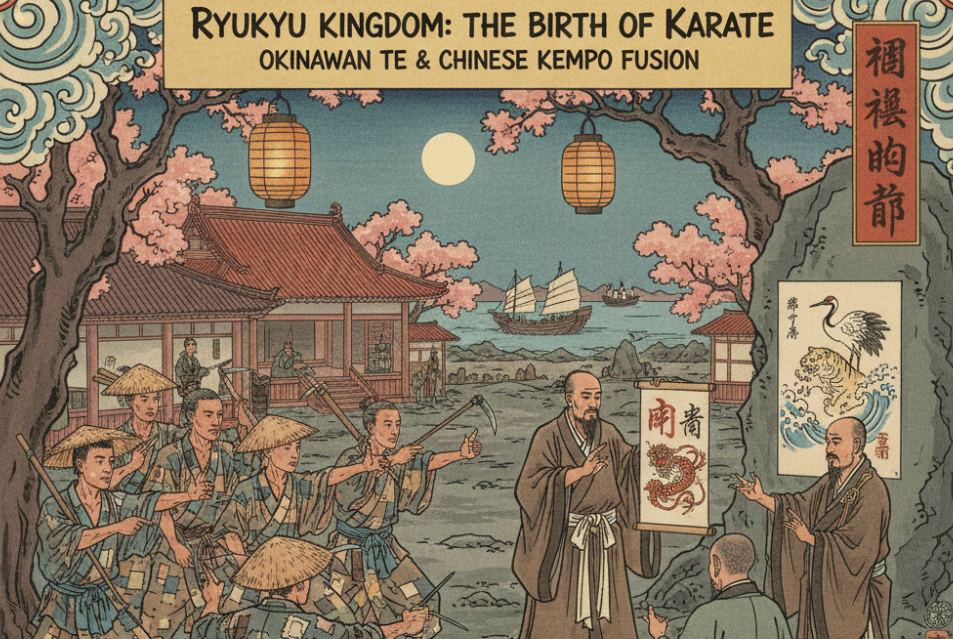
Karate, a martial art that’s become a household name, actually began in the Ryukyu Islands, the lush paradise now known as Okinawa, Japan. This fascinating journey traces back centuries, with powerful ties to Chinese martial arts. That’s right, karate was influenced by Chinese Kung Fu! It’s a melting pot of styles that makes karate unique among martial arts.
Picture this: the 14th to 19th centuries, a time when trade was booming between Ryukyu and China. During these years, Chinese martial arts were introduced and blended with native fighting styles. This fusion birthed what we now recognize as karate. The very word ‘karate’ means ’empty hand,’ highlighting its focus on skill and technique over weaponry.
One of the pivotal figures in karate’s history is Gichin Funakoshi, often hailed as the father of modern karate. In the early 20th century, he brought karate to Japan, where it was embraced and evolved into different styles like Shotokan, Wado-Ryu, and Shito-Ryu. Each style added its own flavor, further enriching the art.
Post World War II, karate exploded in popularity outside Japan. American soldiers stationed in Okinawa picked up the art and brought it back to the States. From there, the global spread was unstoppable. Today, you can find dojos in nearly every corner of the world, from bustling cities to small towns. It’s amazing to see how far it has come!
Principles and Philosophy: The Heart of Karate
Karate isn’t just about punches and kicks. At its core, it’s a philosophy that molds both mind and body. It’s a bit like having a guide on living a balanced life, teaching patience, respect, and discipline. This isn’t just dojo talk—these principles can really transform how you interact with the world.
Central to karate’s philosophy is the Dojo Kun, a set of guiding principles students recite to bring focus and intention to their practice. It’s like karate’s very own mission statement, urging practitioners to seek perfection of character, be faithful, endeavor, respect others, and refrain from violent behavior.
Karate nurtures mental discipline and focus, helping practitioners build strong inner resolve. It’s about pushing through the sweat and effort, finding mental clarity in the process. This mental training is equally important as the physical, building a strong foundation for personal growth.
Karate practitioners often strive for ‘kaizen,’ or continuous improvement. This isn’t just limited to perfecting a technique but applies to all aspects of life. Karate teaches that the challenge is with oneself—not others—promoting self-reflection and humility.
Emphasizing character over competition, karate encourages looking beyond the physicality of the sport to seek deeper philosophical truths. Embodying these values can lead to a more harmonious lifestyle, with practitioners often finding themselves less reactive and more centered in their daily lives.
Understanding Karate Techniques: The Physical Practice
In karate, every punch, kick, and block is like a brushstroke in the art of self-defense. The practice breaks down into three main components: Kihon, Kata, and Kumite, each serving a unique purpose in the martial artist’s journey.
Kihon refers to the basics, the foundational techniques that every practitioner needs to master before advancing. Think of it as learning your ABCs before you start writing essays. Drilling these movements ensures that they become second nature, forming a strong base.
Kata is a series of movements and techniques performed in a sequence. It’s like a dance that tells a story, teaching practitioners about balance, precision, and timing. Each Kata is a complete package of techniques, showing how to defend against hypothetical opponents.
Kumite, or sparring, is where theory meets practice. It allows students to apply what they’ve learned in a controlled setting, developing reflexes and strategy. It teaches adaptability, as no two sparring sessions are quite the same, challenging both mind and body.
Physical conditioning is another key aspect of karate training. It’s not just about toughening up the body; flexibility, balance, and endurance are crucial too. Karate practices build overall fitness, enhancing strength and agility, making everyday movements more fluid.
Karate’s techniques and physical demands also spill over into mental resilience. You’ll find that commitment to your practice helps build confidence and a can-do spirit that can transform daily challenges into manageable tasks.
Karate vs. Other Martial Arts: Subtle Differences
Karate may seem similar to other martial arts at first glance, but there are key differences. Let’s take karate and taekwondo, for example. Taekwondo heavily emphasizes high jumping kicks and agility, while karate focuses more on powerful hand techniques and grounded stances.
Judo is another martial art often mentioned in the same breath as karate. However, it’s less about striking and more about throws and grappling. Karate teaches you to defend yourself with strikes; judo wants you to use your opponent’s energy to your advantage.
Brazilian Jiu-Jitsu, a grappling-based art focused on ground fighting, stands in contrast to karate’s upright fighting style. While karate emphasizes striking, Brazilian Jiu-Jitsu involves submission holds and leverage-based techniques.
Chinese Kung Fu, with its wide range of styles, bears a cultural and philosophical relationship to karate. However, Kung Fu often incorporates more circular movements, compared to karate’s direct, linear techniques. Both share a rich history but diverge in style and expression.
Culturally, the distinctions also matter. Karate, steeped in Japanese discipline and etiquette, stresses humility and respect as a lifestyle. This cultural layer adds an extra dimension to the practice, setting it apart from its martial cousins.
The Modern-Day Practice of Karate: A Global Phenomenon
Karate has leaped into the global spotlight, sparking interest across cultures and generations. Its inclusion in the Olympics catapulted this ancient art into a new era, showcasing its discipline and artistry on a worldwide stage. The thrills of competition add an exciting edge, drawing new enthusiasts eager to test their mettle.
Karate schools, or dojos, have spread far and wide. You’ll find them bustling with activity, from small local setups to large international federations. They each provide something for everyone, whether you’re after competition accolades or personal growth.
The community aspect of karate can’t be overstated. It builds friendships and a sense of belonging, all while promoting physical fitness and mental well-being. Many communities see karate classes as a positive outlet for energy and a tool to develop life skills in kids and adults alike.
Technology is making its mark with virtual classes and online tutorials becoming more common. These innovations provide accessibility, allowing more people to embrace karate, regardless of location. With these modern twists, karate continuously evolves, keeping it fresh and relevant.
Looking to the future, karate remains a dynamic practice, balancing its rich heritage with contemporary trends. Its adaptability assures us that it’ll keep inspiring and shaping lives worldwide, preserving its legacy as a beneficial, transformative practice.